

Why EPR Matters Now
Extended Producer Responsibility (EPR) laws are rewriting the packaging playbook. Instead of pushing packaging waste onto municipalities, regulators are shifting responsibility upstream – to the producers, retailers, and brands that put packaging into circulation.
That means your packaging decisions aren’t just about protecting your products anymore. They’re about protecting your reputation, bottom line, and compliance record.
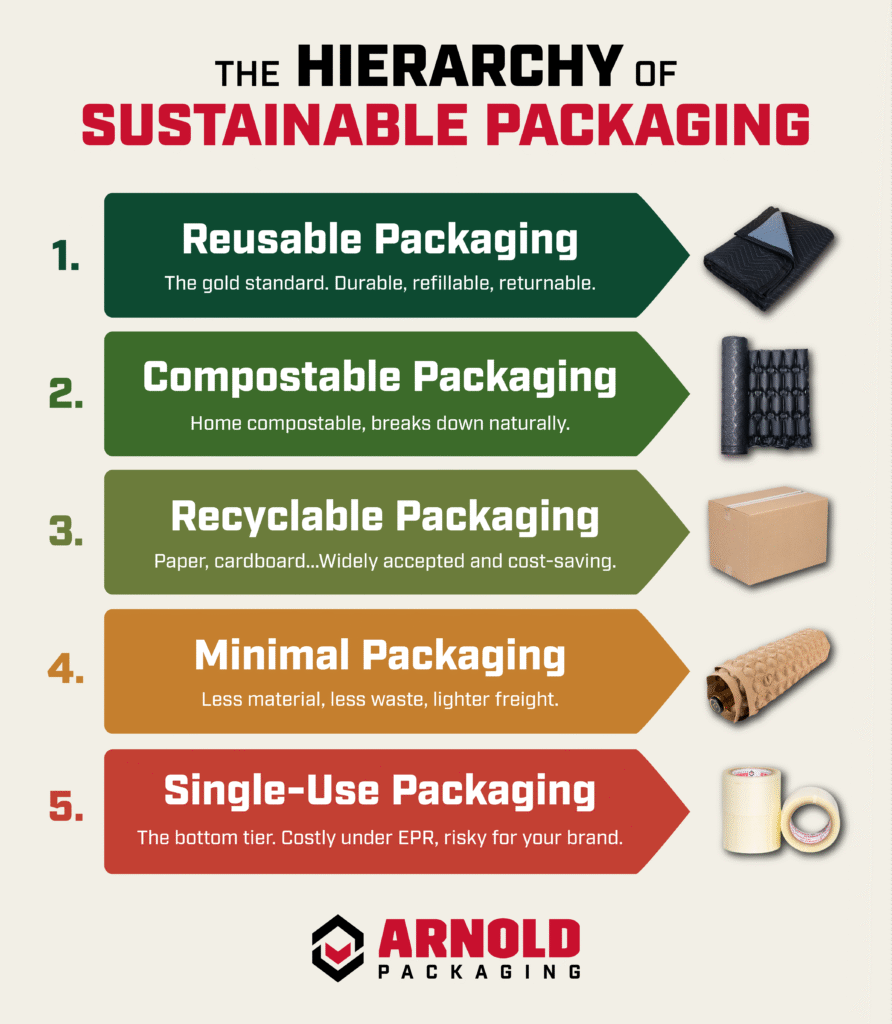
The Hierarchy of Sustainable Packaging
Not all eco-friendly packaging is created equal. Governments and consumers are ranking packaging types based on how sustainable they really are – and how easy they are to keep in circulation. Here’s the clear hierarchy:
1. Reusable Packaging (The Gold Standard)
♻️ Designed to be used again and again. Think returnable crates, refillable containers, and reusable totes.
- Why it matters: Reduces total packaging waste, cuts replacement costs, and scores highest under EPR frameworks.
- Best for: Closed-loop supply chains, subscription models, or repeat-shipment businesses.
2. Home Compostable & Biodegradable Packaging
🌱 Breaks down naturally, often made from starches, fibers, or other bio-materials. (Example: PlantWave™ air cushion film – 100% home-compostable.)
- Why it matters: No microplastics, consumer-friendly disposal, and growing favor in EPR compliance scoring.
- Best for: DTC brands, eco-conscious retailers, fragile-item shipping.
3. Recyclable Packaging
📦 Materials like corrugated cardboard, paper, or certain plastics (PET, HDPE) that can be widely recycled.
- Why it matters: Easily processed in most municipal recycling systems, lowering your fees under EPR.
- Best for: Shipping boxes, protective inserts, or any high-volume packaging.
4. Minimal Packaging (Source Reduction)
📉 The simplest form of sustainability: using less.
- Why it matters: Less material = lower costs, lighter shipments, and lower EPR fees.
- Best for: Retail-ready products, e-commerce, or businesses with high freight costs.
5. Traditional Single-Use Packaging (The Bottom Tier)
🚫 Materials that are difficult to recycle, like mixed plastics, foams, and films.
- Why it matters: Higher costs under EPR, higher landfill rates, and a negative brand perception.
- Best for: Only as a last resort where no other protective solution exists.
How to Stay Ahead of EPR Regulations
✔️ Audit your current packaging materials – know where you stand in the hierarchy.
✔️ Switch to reusable, recyclable, or compostable alternatives where possible.
✔️ Partner with a packaging provider who understands compliance, logistics, and cost savings.
EPR regulations are here to stay – and the businesses that adapt early will save money, build trust, and lead in sustainability. By understanding the hierarchy of sustainable packaging, you can make smart choices that protect your products, your reputation, and the planet.
👉 Need help choosing compliant, cost-effective packaging? Arnold Packaging has the expertise and the eco-friendly products to guide you every step of the way.
📞 Call Arnold Packaging today to get started: 855-276-6537 or email us at info@arnoldpackaging.com.
Laura Cadden
Arnold Packaging
Protecting Your Product & Your Profit
P.S. To keep abreast of the states implementing EPR regulations, this website is a tremendous resource.


